Money Talk With Tiff
ExplorePodcast overview and latest content
EpisodesBrowse the full episode archive
TopicsDiscover episodes by category
PostsBrowse published articles & write-ups
Preorder the book
Main Site

Podcast

  • Explore
  • Episodes
  • Topics
  • Posts

Topics

  • Personal Finance
  • Budgeting
  • Entrepreneurship
  • Financial Education
  • Financial Planning
  • Money Mindset
  • Financial Literacy
  • Debt Payoff

Recent Episodes

  • Why I Delete Most Guest Interviews
  • Why Strategic Rest Beats Hustle Culture
  • The Biggest Money Myth High Schoolers Believe
  • Financial Social Worker Explains Why Your 'I Don't Have Enough' Is Usually Wrong
  • I Almost Lost My Life Insurance Over an ACH Error — What We Learned

Links

  • Apple Podcasts
  • Spotify
  • YouTube
  • Overcast
  • Amazon Music
  • Preorder the book
  • Main Site

About

Money Talk With Tiff

Money Talk With Tiff

    All Topics

    3.3 Rule

    2 episodes
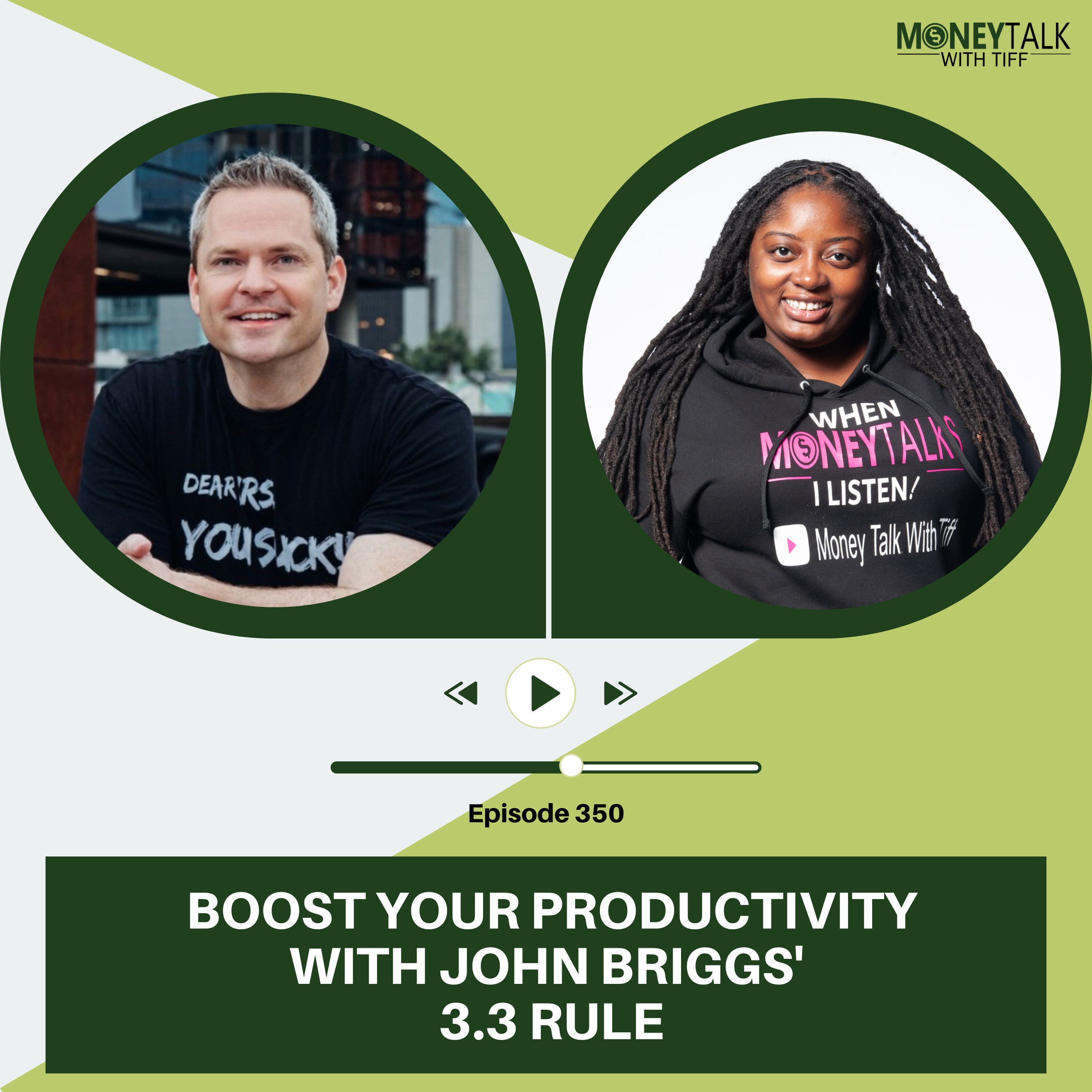
    Boost Your Productivity with John Briggs' 3.3 Rule | Ep. 350

    Boost Your Productivity with John Briggs' 3.3 Rule | Ep. 350

    Oct 31, 202418 min

    In this episode of Money Talk with Tiff, host Tiffany Grant dives deep into productivity hacks with John Briggs, a CPA and productivity expert. John discusses his revolutionary "3.3 Rule," which is designed to help individuals enhance their productivity by working up to three hours at a time followed by a 30% recovery period. This flexible rule allows for personal adaptation and helps you maintain a flow state without burning out. John also shares interesting historical insights behind our conventional work schedules and provides actionable tips tailored for both employees and business owners. Check out thee full show notes: https://moneytalkwitht.com/podcast-show-notes/3-3-rule-productivity/ Key Takeaways The Origin of the 40-Hour Work Week: The traditional work schedule was created by Henry Ford to sell more automobiles, not based on scientific evidence of productivity. Understanding the 3.3 Rule: Work for up to three hours, followed by a 30% break to reset and rejuvenate your mind. Adapting the Rule: The rule is flexible and can be adapted to one's individual tasks and flow state. Science Behind the Rule: Insights from Alejandro Lleras' research on attention and the need for periodic breaks to maintain focus and productivity. Effective Break Activities: Engage in activities that don't stimulate the brain in the same way as work, such as tactile tasks, nature walks, or watching comedy. Benefits of the Rule: John shares testimonials, including a story of someone who incorporated the rule and experienced not just increased productivity but also health benefits. Resources Mentioned Book: "The 3.3 Rule: New Workday Standard to Get More Done by Working Less" by John Briggs (https://amzn.to/3BY3Qpd) Book Website: 33rulebook.com (http://33rulebook.com/) Where to Find John Briggs LinkedIn: John Briggs, CPA (https://www.linkedin.com/in/john-briggs-cpa/) YouTube Channel: Insights Tax (https://www.youtube.com/@Incitetax) on YouTube Connect with Tiffany Website: moneytalkwitht.com (https://www.moneytalkwitht.com) Social Media: @MoneyTalkWithT on all platforms This podcast uses the following third-party services for analysis: Podcorn - https://podcorn.com/privacy OP3 - https://op3.dev/privacy
    John Briggs3.3 Ruleproductivity
    Why Strategic Rest Beats Hustle Culture

    Why Strategic Rest Beats Hustle Culture

    Jul 11, 202622 min

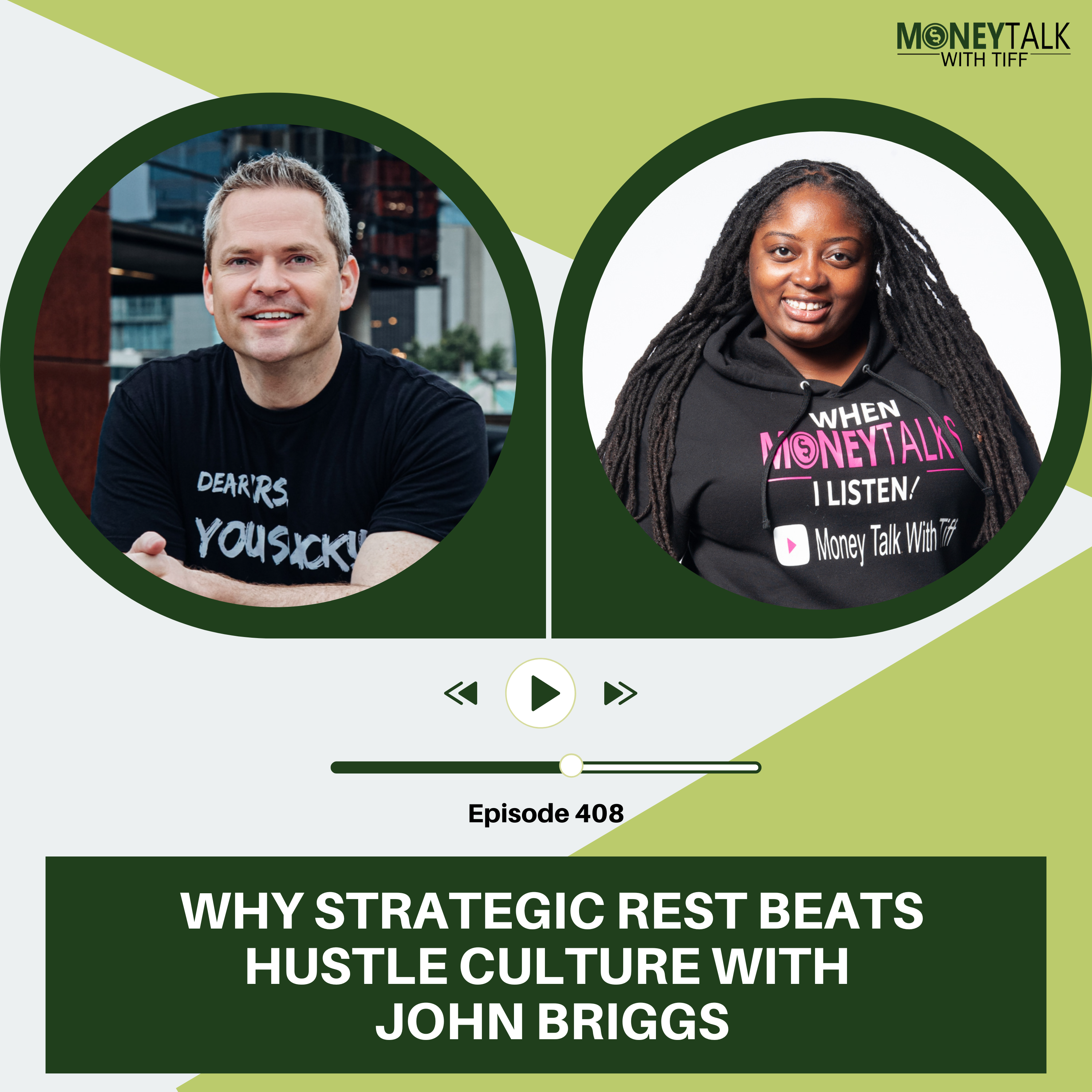
    I used to think the more hours I worked, the more I loved my family. I was wrong. John Briggs was grinding 18-hour days — 5 a.m. to 2 a.m., three hours of sleep, crushing it by every hustle-culture metric. Then his wife met him at the door at 2 a.m., hyperventilating, and told him she was a single parent. Not angry. Not negotiating. Just true. That night in 2010, two promises collided: the oath he made at his wedding, and the "magic formula" hustle culture sold him — more hours equals more money equals success. The second one was winning. The first one was dying. It took three years of research, not a flip of a switch, to build what became the 3.3 rule. John read the work-life balance books, found the productivity science, tracked the patterns across experts — and discovered they were all pointing to the same range. Work. Rest. Work. Rest. Not because rest is nice. Because rest is fuel. In this episode, John breaks down the NASCAR analogy that changed how I think about breaks: the car going 200 mph doesn't win by skipping pit stops. It wins by taking the most strategic ones. Tires shred. Traction fails. The driver who never stops eventually can't keep going — not because they quit, because the machine breaks. We also cover: Why "I'm too busy to take a break" is the same as "I'm too busy to get gas" The first practical step: block one hour after your first 2-3 hours of work today. No work. Walk outside. Let your brain reset. Why John calls it work-life harmony, not balance — balance implies equal weight, and some seasons don't allow that How he turned a tax firm bus already in motion into a luxury RV without crashing it first John is the founder of Incite Tax, a firm with over 250 employees across 30 states. He learned this the hard way so you don't have to. Previous episode with John: https://podcast.moneytalkwitht.com/episodes/boost-your-productivity-with-john-briggs-33-rule-ep-350 🎯 moneytalkwitht.com/start (https://moneytalkwitht.com/start) #hustleculture #worklifeharmony #3.3rule #productivity #entrepreneurmindset #burnoutprevention #smallbusinessowner #worklifebalance #moneytalkwithtiff #stewardship #restisproductive #johnbriggs #insighttax #financialcoach #productivityscience

    John Briggs3.3 rulehustle culture

    Related Topics

    Entrepreneurship75Financial Education58Money Mindset47Debt Payoff34Side Hustle17Work-life Balance15